



The Mystery of the Human Hobbit
An Exciting new Discovery, or an Embarrassing Blunder?
Horizon – The Mystery of the Human Hobbit
600km east of Java in the Indonesian archipelago lies an island that time forgot. It is a world of smouldering volcanoes, flesh-eating dragons and miniature elephants, the island of Flores. Two years ago a team of archaeologists were on a routine investigation when they made an unexpected discovery.
In a cave, deep in the jungle, they unearthed some human remains. The body was only a metre long, which they assumed were the remains of a young girl. They sent off samples of earth from around the body to establish when she had died. The results showed that she was 18,000 years old. With great care, they removed her from the grave, and what they saw made no sense,
All the cranial sutures were healed up, the wisdom teeth had erupted and the teeth were very worn. All of these facts suggested an adult and not a child as they had first thought.
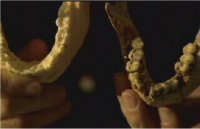
Jaws for comparison
Further analysis of the skull showed, to Peter Brown the team’s bone expert, a receding chin, a narrow jaw and twin-rooted teeth, all characteristics that are very unlike a modern human. The Flores jaw was narrow and V-shaped while the modern human jaw is broader and parabolic. Furthermore, the dates didn’t make sense. 18,000 years ago the modern Homo Sapiens was supposed to be the only species of human left on the planet. The scientists are convinced that this is not a modern human and so are faced with the puzzle of where this might fit into human evolution.
They begin to compare the body to a range of possible human ancestors. They begin with our earliest known ancestor, Australopithecine, they were almost as small as the Flores skeleton but there were few other similarities. It did not share distinctive Australopithecine characteristics and, Australopithecines never set foot in Indonesia.
The other early human of similar stature was Homo Habilus, but Habilus died out one and a half million years before the Flores woman lived. More recent humans like the Neanderthals lived nearer her time, but their frame was far more thick-set.
Looking more closely at the shape and size of the skull made it clear that it was most like that of Homo Erectus who is known to have inhabited Java. But at one metre tall, the Hobbit was almost half the size of Homo Erectus. Evidence of sophisticated tools and weapons implying teamwork and a possible language, set the Hobbit far apart from Homo Erectus.
The mystery deepened when they measured the brain cavity, for despite evidence of intellect the brain was smaller than a chimpanzee’s. Everything about her challenged our understanding of what it means to be human. The team believed they had found an exceptional new species of human being.

Professor Teuku Jacob
Much to the horror of the discovery team, the Hobbit bones disappeared. It turned out they had been borrowed, without permission, by Professor Teuku Jacob of the Gadjah Mada University in Yogyakarta who is considered Indonesia’s authority on Homo Erectus. He argues that he had permission and simply wanted to see this new find for himself.
Professor Jacob, after examining the bones, declares that they don’t look like any Homo Erectus he has ever seen, in fact, they don’t even look primitive. He is convinced that this is a modern human and thinks her descendants might still be alive.
In Chicago, more doubt is a bout to be cast on the Hobbit theory. Professor Jim Phillips, a stone tool expert, of the University of Illinois says "The Hobbit is a case where the evidence of the stones does not fit the bones". He contends that the stone tools found with the Hobbit are far more sophisticated than anything found with Homo Erectus. The stone tools found with the Hobbit are the tools of a modern human.
The assault on the theory of the Hobbit was gathering force. Another scientist was about to join the ranks. Professor Bob Martin of the Field Museum in Chicago thinks the Hobbit’s brain is worryingly small and he claims the discoverers have overlooked a fundamental law of biology. "What this law says, in simple terms, is that if you half body size, brain size is only reduced by about 15%". According to this basic biological law, the one metre tall Hobbit should have a brain size of 750cc, but the individual discovered in Flores has only a brain size of 400cc.
The team behind the discovery believe there is a loophole in this law. They say that evolution on a remote island will not follow conventional wisdom. This is how, over thousands of years, a Homo Erectus shrank to become a small-bodied, small-brained Hobbit. Professor Bob Martin refutes this, arguing that humans have lived in isolation on many islands without shrinking, and the Flores theory is not scientific.
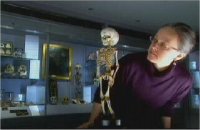
Microcephalic Skeleton
Professor Ann MacLarnon of Roehampton University, London says of the Hobbit "The Flores specimen is a very odd fossil, particularly the size of the brain. This size of this brain with this body just isn’t normal, so meybe you need to begin to think was something abnormal about the specimen". In London’s Royal College of Surgeons she has found a specimen with striking similarities to the Hobbit. The specimen is known to have been about 3 years old when she died but the body is little bigger than a new born baby. This infant had a condition known as microcephaly.
Microcephaly can result in dwarfism and it has one other classic characteristic, as well as resulting in a small brain, it also affects the face and jaw and could explain the Hobbit’s unusual jaw shape and twin-rooted teeth. These deformities could easily be mistaken for primitive features. To make a scientific comparison she needed to find a microcephalic brain of a similar age to the Hobbit. Hidden away in the museum vaults she found just what she was looking for. She measured the brain capacity of the modern microcephalic and found it to be almost exactly the same as the Hobbit’s.
Professor Jacob and his team travel to the village of Rampasasa on Flores, less than a kilometre from the Liun Bua cave where the Hobbit was discovered. Jacob wished to examine the features and stature of the villagers to see if they could be the living descendents of the Hobbit. The villagers are unusually short, but not as short as the Hobbit. While the team are present they are visited by a distinguished local, the village elder. Johannes Daak stopped counting his years a long time ago, but it is rumoured that he is over one hundred. Johannes is short, short enough at 1.33m to be classified as a pygmy. Although Johannes is a foot taller than the Hobbit, if he had microcephaly, he would be much smaller, with a small brain.
The Hobbit sceptics agree that this explanation fits the facts much better. If the people of Rampasasa are the descendents of the Hobbit then they are living, breathing proof that she was not a different or new species.
This is not quite the end of the story. The original discovery team have not given up. They return to Flores to look for further evidence and find another jaw in a new cave. When they X-Ray this jaw they find the same twin-rooted teeth, which they claim, vindicates their theory. The chances of two cases of microcephaly are, they argue, so small as to be almost impossible. Peter Brown has been swayed a little and has now decided that the Hobbit, or Homo Floresiensis as it has been dubbed, did not evolve from Homo Erectus, but from another small-bodied ancestor. If this is the case, then this small-bodied ancestor is unknown to modern science.
CREDITS: All of the above information came from the BBC "Horizon" series of programmes.
